We had a great SIG meeting at CHI2018 in Montreal – Canada (https://chi2018.acm.org/). The SIG hosted over 30 distinguished HCI researcher. Here I would share the summary of the discussion which I believe it can be useful for HCI researchers who are interested in “Engagement”.
Here is the link to the original SIG paper: https://doi.org/10.1145/3170427.3185364
Approaching Engagement towards Human-Engaged Computing
The discussion has been done in 4 tables (groups) where G1, G2, G3, and G4 discussed engagement theories, engagement examples, humane direction, and HEC.
Engagement Theories – Group 1
We found that Engagement is a very messy concept, as there are so many different aspects! So, we talked about whether we should look at engagement as a computer-mediated communication or HCI, and then we discussed that we should look at it as action, activity or practice on different levels.
It seems that it is easy to measure it if we look at engagement on the individual level, and then we talked that it is important to come up with a measurement. Related to that looking at different aspects of engagement, so how to define the engagement and what is the difference between engagement and experience. And should we consider engagement on a positive or negative side?
We spent time talking about ALEXA! So, depending on a task such as a simple step or multi-steps, we need to define different types of engagement. We discussed locus of engagement! We think that, as technology becomes more accessible, we can look at engagement across devices or engagement with a particular one device or technology.
We also talked about the meaningfulness of the engagement!
Later we talked about video watching as positive or negative examples of the engagement.
We also recognized that often different players or different users might think that this way of technology use is great, but their family members may have an opposite idea.
We talked about longitudinal aspects of the technology too, discussing that how engagement is not momentary only and it might be considered as a longer-term engagement such as particular service or device. For example, asking a momentary question to ALEXA the fact that we always turn to ALEXA all the time shows that it is a long-term engagement.
Engagement Examples – Group 2
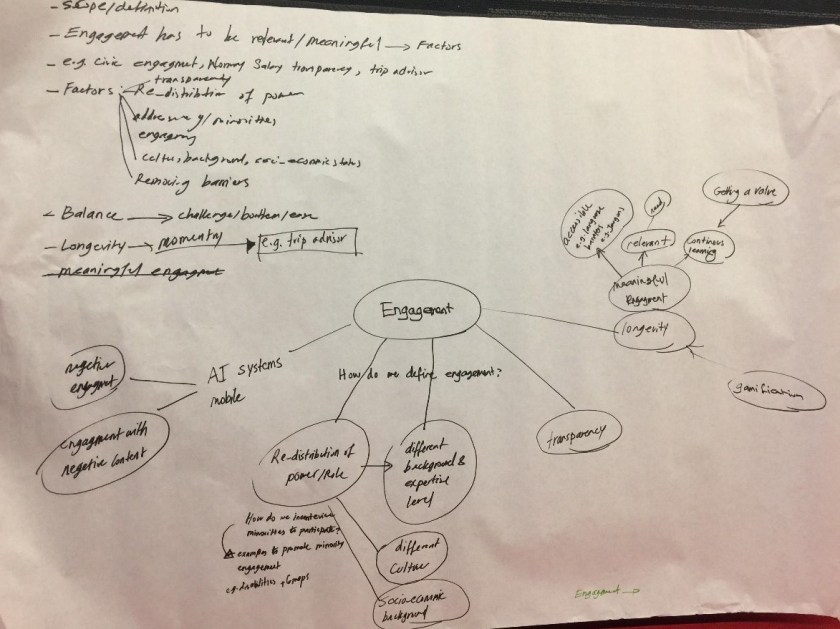
First of all, we decided that we do not know exactly what we mean by engagement! So, we need to come up with an overarching definition of the engagement. We also talked that engagement should be relevant and meaningful. So, what factors that can make the meaningful engagement such as adding a value or continues learning or addressing a need something that makes meaningfulness for people.
In terms of engagement examples, we talked about civic engagement, and how to build a technology to engage everyday people with civic decision-making. We talked about Norway salary transparency, and how transparency can increase the engagement. We talked about trip advisor as an example of how they want to make it more longitudinal as well.
We talked distribution of power as an important factor. How we can sure that minority people can also engage. Maybe create a tool to specifically addressing minorities point of view.
We talked about culture, background, and socioeconomic aspects in terms of factors that can affect engagement, and also, we discussed that how they can be barriers such as language, access, etc. and how we can come up with balance for engagement. We finally discussed the gamification aspect of the engagement.
Q/A between Group1 and Group 2
Q) What is the example of non-meaningful engagement?
A) Maybe engagement with negative contents!
Q) Okay. So, in the eyes of the person doing it or societies’ eyes?
A) Non-meaningful engagement could be minus engagement such as scrolling through social media apps without even being aware that what we are doing
Q) Or playing solitaire one of the most popular computer games? Is that meaningful?
A) Gamification is intentional when you are playing the game and you are aware that you are playing the game, but a lot of the people report that while using social media they found themselves engaging but without being aware that what they are doing at the moment. So, it provides less meaning and it is not the mindful use of technology.
Q) There are many people that they stay away from the technology. Is this also an example of the non-meaningful? How we could define it in terms of engagement.
A) I think this is related to expertise and background level of the users, which it affects engagement. If you are not expert in using technology, if you are not familiar with the content it will affect your engagement with technology. For example, if we are not expert/familiar in visualization, we do not engage with visualization tools. And I think your question is also about non-use of technology which there is no engagement at all.
Humane Direction – Group 3
We started with mapping positive engagement versus negative engagement. Positive engagement could be for example a sense of flow or sense of slowing down which means to disengage when it is necessary to disengage. Versus the negative part which is really addictive that you cannot stop even if you want/have to.
We talked about transcendence means that is it engagement becoming bigger than yourself? I am not sure I can explain well the concept, but it means having higher meaning and purpose and more transformative experience through connecting the technology, versus the negative side which it is more selfishness such as only looking at your own needs and not considering connecting with the other people.
We also discussed the disengagement that I already mentioned meaning that who controls the engagement? Is it us the users or is it actually the companies or the app developers. Because traditional media has always an end! A book has an end, a movie has an end. But the new digital media keeps ongoing and it is really hard to disengage from the technology! We talked about the tricks that companies use, we talked about what if the human brain can detect those dangers and tricks. Like we talked about dopamine and behavioral changes and so on those things that actually control our engagement outside of us.
Then we looked that what is this humane direction as it is our topic. What is this Do Not Harm? We talked that well there are always certain risks, so you need to find a balance between doing good and trying to minimize potential consequences. It means that while creating these engaging applications we need to keep asking questions. And if we see that we are going in a direction that there is more risk and there are more negative consequences we should redirect and go in a different direction.
Identifying assumptions that we make when we design the applications, designing context for people, understanding the diversity of the users in not only in macro level but also in micro level are some other topics that we discussed.
We also discussed the balance of creativity. For example, engagement should be something for creativity or it could be also something for relaxing such as playing a game or watching a video if you just enjoy that engagement. And finally, we talked a bit further about the responsibility and accountability of the designers that it does not stop when your product is shipped. And designers should be aware of what is happening beyond that, during a whole lifetime. And the focus should not be about only designing tools but also about the whole infrastructure about that technology. If you are a car designer, you should think about the road to it.
Last, all that is needed for evil to prevail, is for good men to do nothing? Checks & Balances, Support/Empower, Awareness, Digital Literacy, Education.


Q/A between Group 2 and Group 3
Q) Did you discuss the fear to regulate the engagement?
A) So, no actually but this is a good point to discuss. For example, when you are booking a flight or hotel this is not something that you really want to engage with it, but you are engaging. I think it could be related to the framework of internal or external control. When you are afraid this is something external that controls your engagement rather than yourself having a feeling that you are controlling your engagement.
HEC & SIG – Group 4
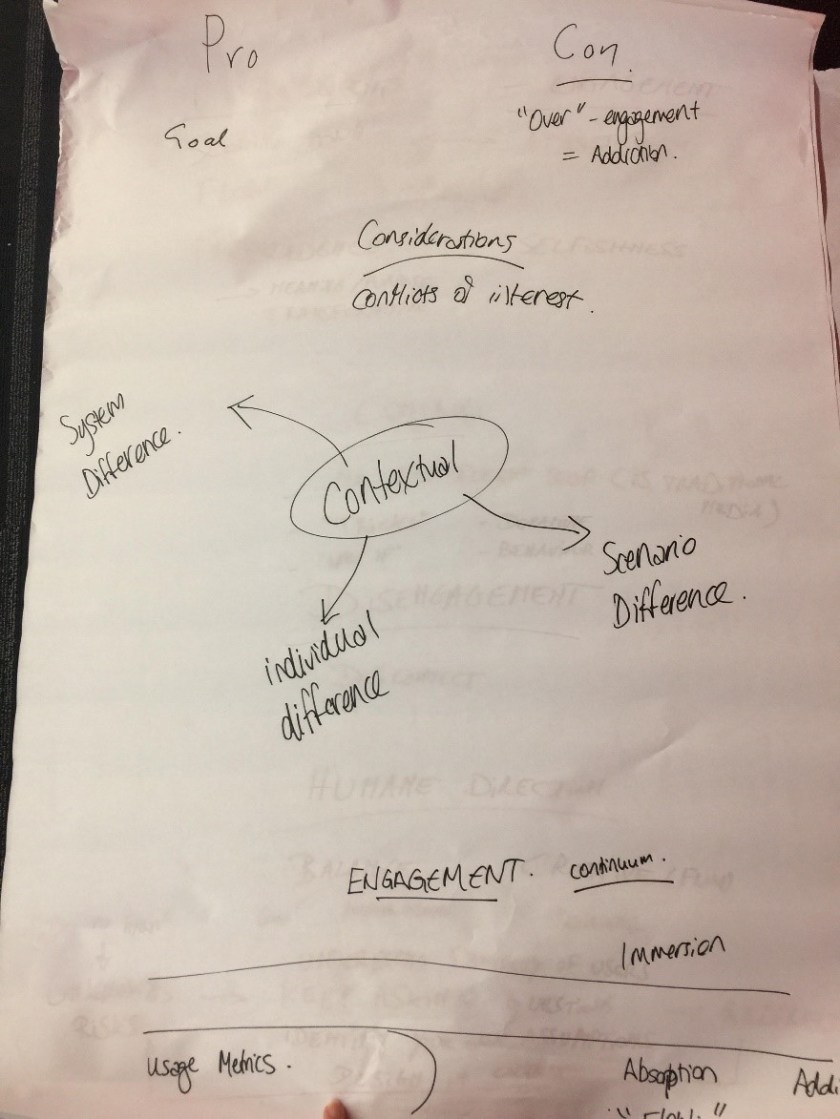
We discussed the engagement in a different way compared with what is described in the literature. So, we consider the behavioral aspect of the engagement which could be like usage metrics. So, what amount of time we spend using applications, click some different parts of it. There is also the experiential perspective of engagement which what causes a lot of attention. We drew a figure in terms of depth of engagement to reconceptualize it from very surface levels such as usage metrics to the absorbed level and more experiential level which it is very immersive, and then at the very end the addiction level.
We discussed that designers should be very mindful of the context of the system, and we should be aware of different scenarios, individual differences and with different types of systems. For example, my background is health behavior change. So, I am interested in designing apps to change people’s behaviors to improve their health. So, for example, I give you the app and then you start to use it and then stop using it after a while, from my point of view it could be a good thing. Because although you are disengaging, you learn a lesson and you got your need, and it means that I as a designer also got what we aimed because I could change your behavior.
So I think it is very important for us as people in this industry to be mindful because we are making the best use of participants time, and we want to engagement to be meaningful and purposeful.
Finally, we said that the real difficulty in this space is a conflict of interest. For example, social media like Facebook they want to keep your attention as they are a product, while part of researchers and developers are against it!
Q/A between Group 2 and Group 4
Q) My question is just a comment. I really love your point of view about how shallow metrics are for evaluating user engagement. For example, hey people how many times user looked, involved or clicked on the content. But for me, those are not metrics of engagement. My framework goes from viewing to understanding to learning to be able to make a decision or forming a hypothesis.
A) Group 4 agreed on the comment. Group 4 speaker (Anonymous) wrote a blog about engagement and asked participants to read it.
 KAVOUS SALEHZADEH NIKSIRAT